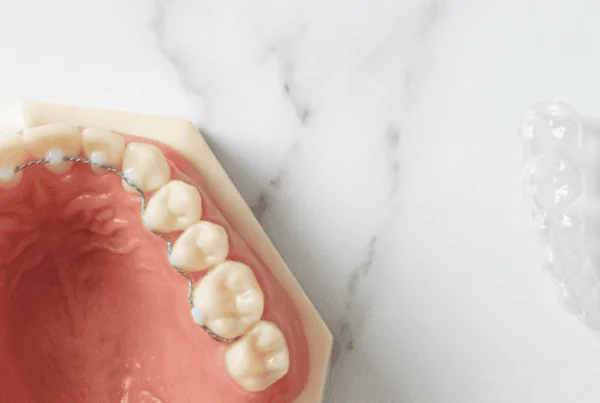



Invisalign attachments are small composite resin bumps bonded to your teeth that help aligners grip and move teeth in precise directions. They’re tooth-colored on day one, but their porous surface means they stain and collect plaque differently than enamel — something most patients don’t hear about until it happens.
The Staining Reality Nobody Warns You About
Most people who come to me asking about Invisalign in Bakersfield want to know one thing first: will anyone notice? I tell them the honest answer — attachments are designed to blend in, but they don’t stay invisible the same way your natural enamel does.
Here’s why. Attachments are made from composite resin, the same material used in tooth-colored fillings. Composite resin is more porous than natural enamel. That porosity is invisible to the eye, but it matters enormously for staining.
Think of it this way: your enamel is a glazed ceramic tile. Your attachments are unglazed clay. Both look similar when new. But after weeks of coffee, turmeric, red wine, or dark sauces, the unglazed surface absorbs color while the glazed tile wipes clean. That’s why patients near the Fox Run area sometimes tell me their attachments “appeared” after a month — they were never truly invisible, they just became more visible as the resin absorbed pigment.
A few specific staining risks worth knowing:
- Turmeric and red wine penetrate composite resin faster than most foods because their pigment molecules are small enough to enter the pores directly
- Coffee without a straw is a daily offender — even brief contact during your 22-minute mealtime window accumulates
- The halo effect is real: plaque collects along the bond line where the attachment meets the tooth, creating a yellowish border that outlines the attachment against your enamel
The practical fix is simple. Brush immediately after removing your tray for meals, rinse before reinserting your aligner, and ask me about a polishing appointment if the staining is bothering you. Avoiding highly pigmented foods during your eating window helps more than most patients expect.
How Attachments Actually Move Your Teeth — The Biomechanics
Clear aligners work by creating a shape mismatch between the tray and your current tooth position. Your teeth move because the aligner pushes them toward its shape. But for complex movements — rotations, extrusions, torque — that push alone isn’t enough.
Research published in PMC confirms that attachments act as force transducers, increasing the contact area between the aligner and tooth and shifting where the force is applied relative to the tooth’s center of resistance. Without an attachment, the aligner pushes a smooth curved surface. With an attachment, it has a precise geometric anchor to push against.
Different shapes serve different purposes. Rectangular attachments placed horizontally encourage vertical movement — useful for extrusion. Placed vertically, they help close gaps through mesiodistal movement. Beveled attachments are often used for extrusion because their angled surface directs force in a specific direction. Ellipsoid attachments are smaller and typically used in pairs for rotation control.
Not every patient needs attachments. Simpler cases — mild crowding, minor spacing — may progress through the aligner sequence without them. But if your treatment plan involves rotating premolars, correcting a bite, or moving teeth vertically, attachments are likely part of your plan. For patients interested in teeth straightening options beyond clear aligners, there are additional solutions worth exploring.
Rubber bands sometimes work alongside attachments for bite correction. A Healthline overview of Invisalign rubber bands explains that elastics apply directional force between the upper and lower arches — something attachments alone can’t accomplish. The two systems work together.
The Sensation Nobody Describes: Eating Without Your Trays
Patients near Fairway Oaks ask me about discomfort, and I always make sure to cover something the standard explanations skip: what the attachments feel like against your lips and cheeks during meals, when your trays are out.
With the aligner in, the tray creates a smooth shell over everything. Remove it for lunch, and those small composite bumps are suddenly in direct contact with your inner cheeks and lips. The sensation is often described as sharp or sandpaper-like — especially in the first few days.
Here’s a rough timeline of what to expect:
- Days 1–5: The edges of new attachments feel noticeably sharp. Chewing and lip movement drag soft tissue across them repeatedly.
- Days 6–14: Saliva and friction smooth the sharpest edges. The sensation shifts from sharp to simply textured.
- Week 3 onward: Most patients stop noticing them during meals entirely.
If you’re developing a sore spot or small ulcer on the inside of your cheek — which does happen — orthodontic wax applied directly to the sharpest attachment during your eating window is an effective short-term solution. It’s the same wax used with traditional braces, and a small amount pressed over the offending bump creates a smooth surface until your soft tissue adapts. If pain becomes severe or you experience a dental emergency, don’t hesitate to contact our office right away.
How We Remove Attachments Without Damaging Your Enamel
One question I hear often: won’t removing those things scratch my teeth?
It’s a fair concern. The attachment is bonded directly to your enamel, and the idea of grinding something off sounds risky. The reason it’s safe comes down to material science and technique.
A systematic review on clear aligner attachment design notes that composite resin is softer than natural enamel. When we remove attachments, we use composite-removal burs specifically calibrated to cut through resin without cutting enamel. The hardness differential means the bur stops being effective once it reaches the tooth surface — it can’t bite into enamel the way it removes the softer composite.
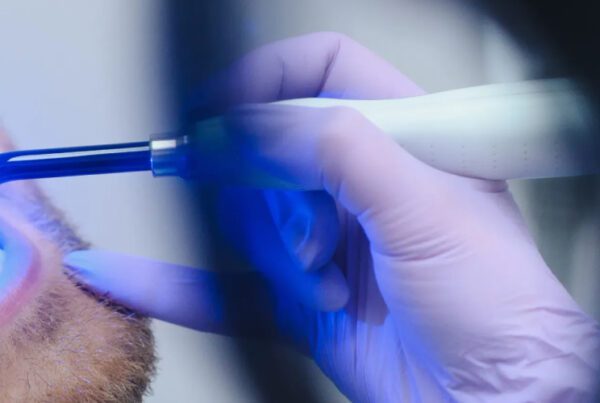
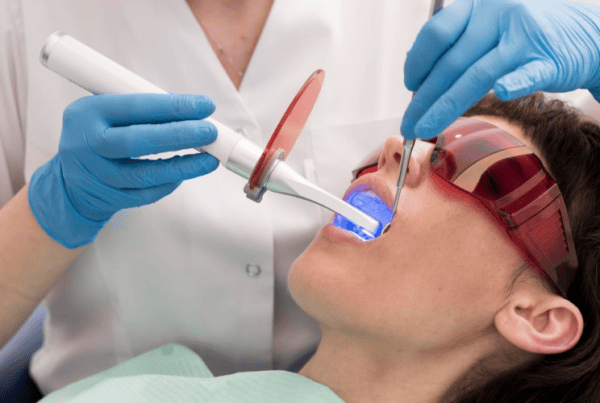
We also use UV or fluorescent lighting during removal when needed. Under UV light, composite resin fluoresces differently than natural tooth structure, giving us a visual distinction between what needs to come off and what stays. This is especially useful for thin remnants that are hard to see under standard operatory lighting.
After removal, a brief polishing step smooths the bond site. Most patients leave with no visible difference on their enamel surface. Following the completion of your Invisalign treatment, scheduling cleanings and exams helps ensure your teeth and gums stay healthy. The process is routine, and for anyone considering Invisalign in Bakersfield, it shouldn’t be a barrier to starting treatment.
Ready to See Whether Attachments Are Part of Your Plan?
Every Invisalign case is different. Some patients move through treatment with minimal attachments; others need several to achieve the precise movements their case requires. The only way to know what your plan involves is a proper clinical exam and digital scan.
At First Choice Dentistry, we take the time to walk through your ClinCheck plan with you so you understand exactly which teeth will have attachments, why they’re placed where they are, and what to expect throughout treatment. We also offer aesthetic dentistry services to help you achieve the smile you’ve always wanted beyond just straightening. Serving patients across Bakersfield — including families near Fox Run and Fairway Oaks — we’re here to make sure you go into treatment informed, not surprised.
Reach out to schedule your consultation today.
Medical disclaimer: This article is intended for general informational purposes only and does not constitute professional dental or medical advice. Always consult a licensed dental professional regarding your specific oral health needs and treatment options.